Traces of colonialism in the collection
There are traces of colonialism at Paleis Het Loo. Willem and Mary and their successors lavishly decorated the interiors with tropical timbers and Asian porcelain. Their gardens were full of rare flowers and plants from colonised regions of the world. These products (objects, animals and people) were specifically sought out, purchased or brought back because they were rare, difficult to obtain and hugely expensive. Showing off such possessions was part of court culture. These objects can be viewed in the online collection, and placed in a broader perspective.
Colonial Cabinet
Paleis Het Loo’s collection contains traces of colonialism which we continue to investigate. This cassone (Italian cabinet) or wedding chest is one example.
King Willem III bought this cabinet in 1872, some years after he had signed laws abolishing slavery. Research has shown that he was a supporter of the abolition of slavery. He grew up with the idea that slavery is wrong Yet he bought this cabinet.
North-Italian atelier, 1850 - 1870.
Paleis Het Loo, Apeldoorn. Long-term loan from the Cultural Heritage Agency of the Netherlands
In Featured: Colonial Cabinet, visitors can hear Dik van der Meulen, who wrote a biography of King Willem III, speaking about the King’s views on slavery, and what role he had in its abolition.
Art historian Elmer Kolfin explains what makes the cabinet so unique and how the images of Black people in chains were part of a broader trend in the 19th century.
Academics Karwan Fatah-Black and Nancy Jouwe focus on the opposition to slavery, and how certain attitudes persisted after its abolition.
And speaker Aminata Cairo considers what emotions the cabinet evokes today.
Abolition and attitudes
In Europe, slavery was abolished by Britain and France (in 1833 and 1848 respectively). After many legislative proposals, King Willem III of the Netherlands signed a law abolishing slavery in 1863. Abolition occurred first in the Dutch East Indies (now Indonesia), in 1860, and on the Caribbean islands and in Suriname in 1863. A large proportion of the enslaved people there had to continue working on the plantations for a further ten years, however, so for many, slavery did not really end until 1873.
In the colonies, King Willem III became the symbol of liberation despite the fact that, like his predecessors, he never visited. Initially, it was mainly the plantation owners who benefited from slavery. In 1863 they received 300 guilders for every enslaved person from their plantation who was declared free.
Ch.J. Abboud, 1964
Paleis Het Loo, Apeldoorn
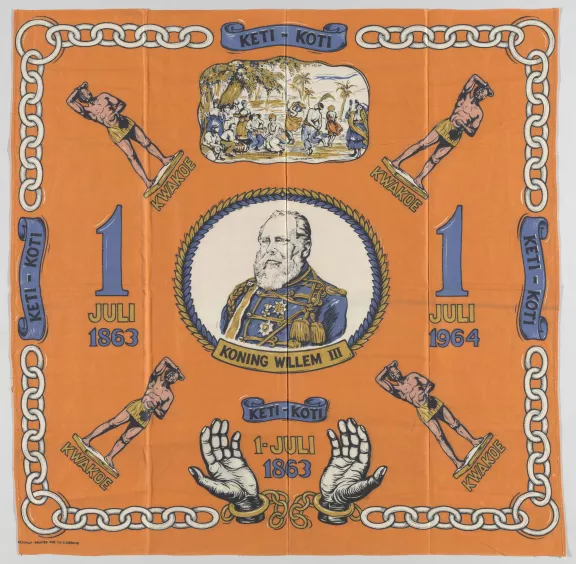
This Surinamese Angisa, or commemorative scarf, from Paleis Het Loo’s collection was made 100 years after the official abolition of slavery, to mark Keti Koti ('broken chains') 1964. At the centre of the scarf is a portrait of Willem III as the king who broke the chains in 1863.
Serving as decoration
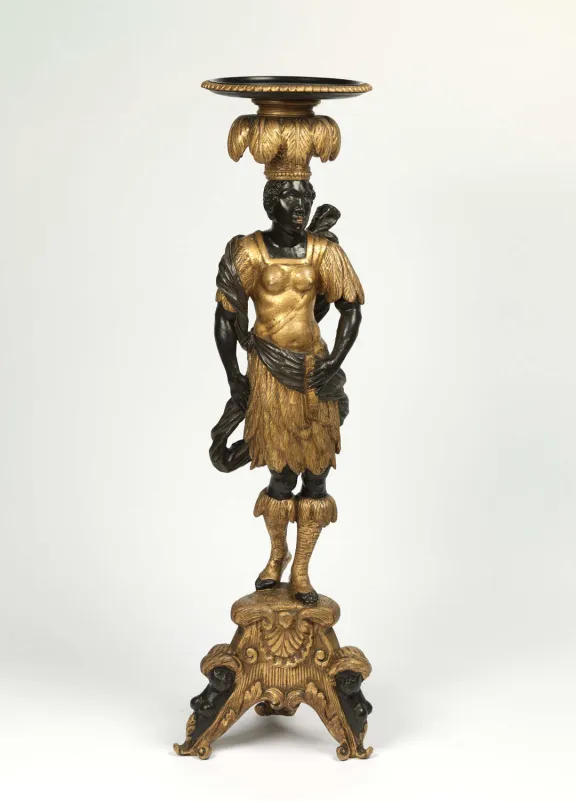
A guéridon is a small table or stand supported by a single leg. It was just big enough to hold a candelabra. The name probably refers to a 17th-century French play, in which a Black man or woman (‘Guéridon’) held up a candelabra. Guéridons became popular items of furniture in European palaces. They would generally be in pairs, placed to the right and left of a table. At the time of King-Stadtholder Willem III and Queen Mary II, white Europeans often displayed their wealth with images of Black people in servile attitudes. Objects like this guéridon tell us more about inequality in the 17th century.