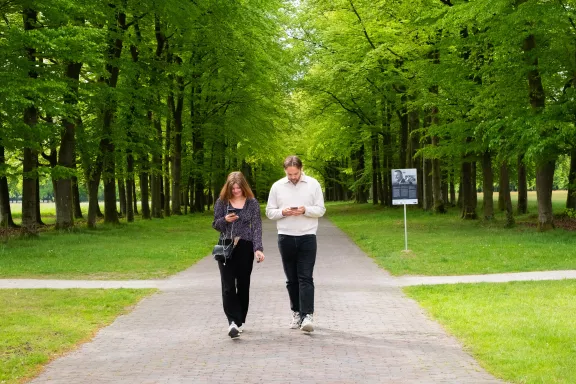
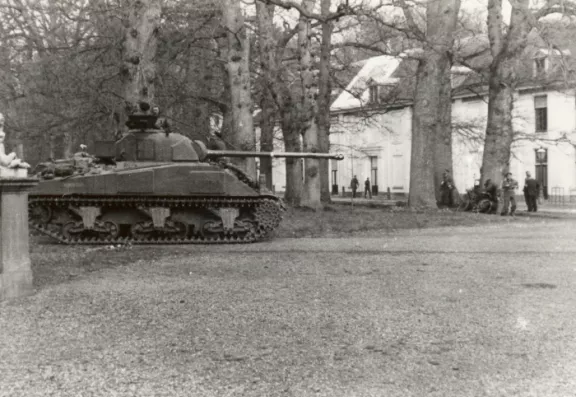
VO: Feel free to walk around the square or take a seat on one of the benches while you listen to this excerpt. Is the blue gate closed? Then you can stroll around the small square in front of it instead.
Music: Dramatic, menacing but minimal music.
VO: During the 1930s, many German Jews fled Germany, fearing Nazi persecution and violence.
Sound: Hitler speech compilation in background, people cheering.
VO: The Netherlands offered little help when they reachecd the Dutch border. Those without proper papers were turned away without mercy.
A public debate began to emerge: should Jewish refugees be allowed in, or not? These kinds of discussions — about whether or not to take in refugees — are as old as time.
This discussion also reached Paleis Het Loo in 1939.
Politicians in The Hague were searching for a place to house the small number of Jewish refugees who were allowed into the country. An ideal location for a refugeecamp, they believed, was a patch of the nature park the Veluwe near Ermelo – on land bordering the grounds of this very palace…
The plan faced strong opposition from various organizations. Some feared the camp would harm tourism in the Veluwe, others that it might disturb their Sunday rest.
Queen Wilhelmina thought it was far too close to her beloved Paleis Het Loo – at 12 kilometers away.
It was a widely shared sentiment: people were willing to help refugees… just not in their own backyard.
In the end, the camp was never built.
- pause
Music: Neutral music, with a sense of urgency.
VO: Eventually, m ore serious thought was given to how Paleis Het Loo’s vast collection could be protected in the event of a war.
In November 1939, all valuables were removed from the palace’s reception rooms.
But when the intendant — responsible for managing the palace — asked Wilhelmina whether the valuables in her private quarters should also be hidden, she responded furiously:
VO (with echo): "Leave everything, [...] I want to be able to go to Het Loo every day and find the whole place as I left it [...]]"
VO: That firm stance proved short-lived. As the threat of war grew, the situation became so serious that — within weeks — tapestries and other artifacts were nevertheless hidden, in a room beneath the kitchen in the palace’s right wing.
Paleis Het Loo, a national symbol, was beginning to lose its splendor.
VO: On May 10, 1940, what many had feared happened: Germany invades the Netherlands.
Music: Dramatic, urgent.
Sound: Radio fragment: Germans have been invaded
VO: It is likely that the Germans aim to seize control of the government – and possibly take the royal family hostage.
So, on May 12th, 1940, Juliana and Bernhard fled with their two daughters to England. A day later, Wilhelmina also made the crossing, with a gas mask and helmet within reach.
Five days after the invasion, the Netherlands surrenders. To many Dutch citizens, it feels as if they’ve been left behind by their government and queen. There is anger and disbelief: how could she abandon her people — now, of all times?
Walk to the entrance of the blue palace gate. Then, with your back to the palace, turn left. Walk past the barrier gate, and just before you reach the road, turn left again. Keep walking until you reach the Tuinmanslaan bus stop.
As you walk there, you can listen to the following excerpt.