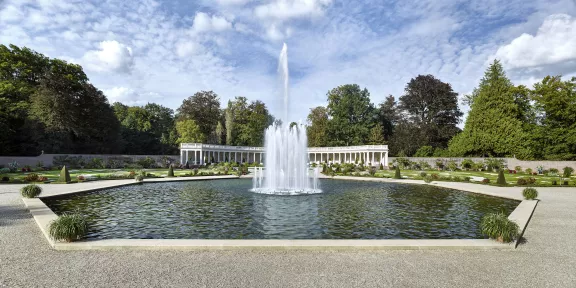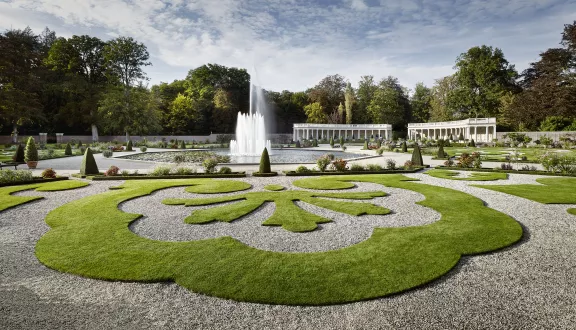
Stadtholder Willem III and Princess Mary had a large garden laid out behind the palace. In their time, gardens are in fact just as important as the palace itself. It is in palace gardens that Willem and Mary could display their power and wealth in all their glory. After all, the gardens are a wonder: perfectly symmetrical and full of unusual plants, flowers and tall fountains in the middle of the wild, dry Veluwe moorland.
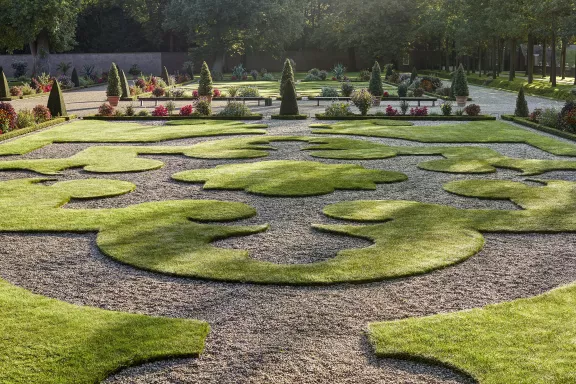
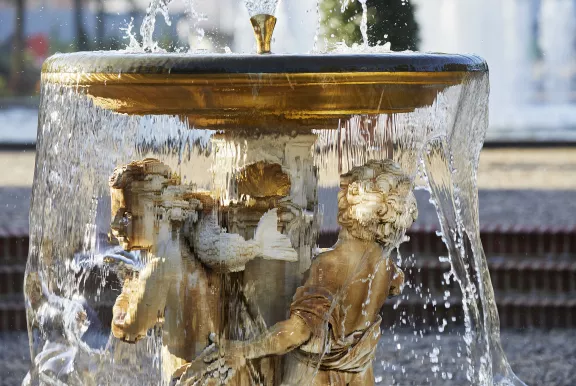
The gardens provide the backdrop for Willem and Mary’s royal life. In the king’s garden, the stadtholder would play bowls or ‘kolf’ (a forerunner of golf) with his guests. Mary and her ladies-in-waiting walk in the queen’s garden, beneath the arbour, to protect them from the sun. The gardens are also a showcase for Willem and Mary’s collection of flowers and plants from Asia and South America, obtained thanks to their connections with the Dutch East India Company and West India Company.
The gardens of Paleis Het Loo are unique, as the only reconstructed baroque gardens in the Netherlands. The highlight is the King’s Fountain, which is more than 13 metres high. It was the highest fountain in Europe at the time.