Biografie
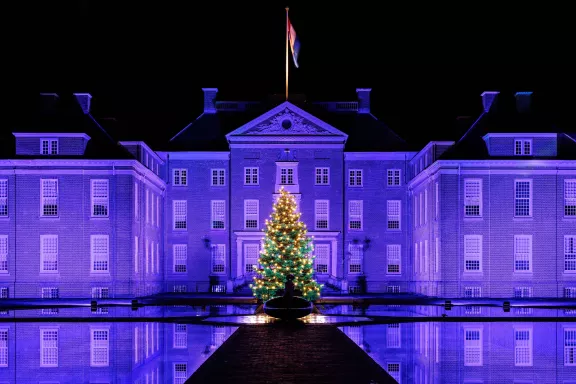
Aymeraude du Couëdic was born in Paris in 1995 and has been living and working in Turin since 2025. She graduated from La Cambre in 2020 and was awarded a grant from the Moonens Foundation in the same year, where she did a nine-month residency. In 2023, the Le Botanique cultural centre dedicated a solo exhibition to her in its gallery space. Her work also later featured in exhibitions at Museum More, Gorssel (2024) and Paleis Het Loo (2025).
Du Couëdic's work explores the tensions between control and freedom, nature and artifice. Her charcoal drawings, paintings and installations combine formal precision with critical reflection on topical issues.
Each project is conceived as an experience in which the materiality of the work contributes to its meaning. In a dialogue between form and content, she invites the viewer to go beyond simple observation du Couëdic combines aesthetics and socially engaged art, subverting classical codes to create images that do not merely seduce, but act. Her work addresses subjects like digital surveillance, waste in western societies and individual complicity in the systems that control us. By catching the viewer’s eye, she raises questions about how people shape their world – sometimes against their better judgment
Paranoptique
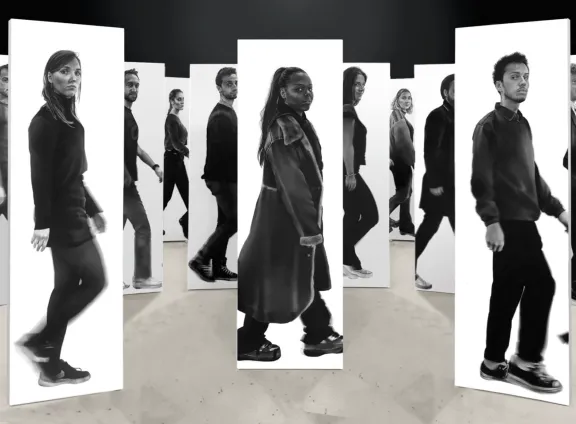
The installation Paranoptique reflects on contemporary forms of surveillance and social control. It was inspired by Jeremy Bentham’s panopticum — a prison design in which prisoners are kept under constant observation from a central tower. Philosopher Michel Foucault used it as a basis for an abstract model of a disciplinary society based on surveillance.
Paranoptique transposes this architecture of power to the digital age. Surveillance and control are no longer imposed by a central authority, but have now been internalised, accepted and reproduced by individuals themselves. Everyone contributes to the generation of data, in full knowledge of its public visibility. Just think of CCTV, facial recognition, biometric passports, digital files, social media, cookies etc. Technologies that were originally intended to liberate people have radically changed relations in our society.
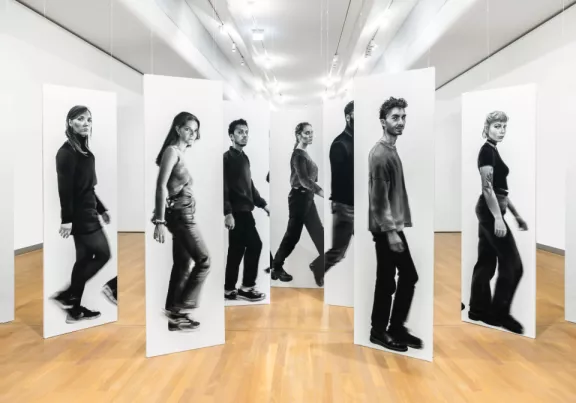
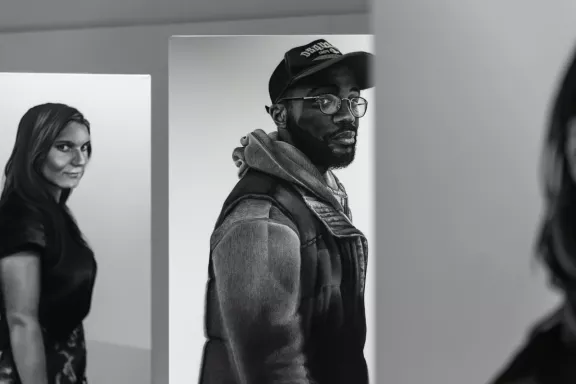
The installation consists of silhouettes drawn in charcoal, slightly enlarged to heighten the feeling of claustrophobia. The installation plunges the visitor into a visually enclosed space. All eyes seem to be following us. The artwork not only illustrates an idea, it turns it into a physical experience. As we move through the installation, we become involved in a game of catching each other’s eye, as we become both observer and observed.
This logic dictates that the centre does not belong to anyone. There, anyone can claim the spot and thus become the symbolic point of control. This dispels the notion of a centralised power, something that is further enhanced by a recent change made to the installation. Originally consisting of circles, Paranoptique is now arranged in the shape of an oval. This geometric shift reflects a change in the nature of power. The circle, perfect and closed, represented the stability of centralised control; the oval, on the other hand, extends, distends and unfolds.
Paranoptique reveals this transformation by distorting the original effect of the panopticum. We no longer live under the surveillance of a single entity, but amid a multiplicity of observers, screens, data and new norms. The installation offers a sensual experience that prompts reflection. Inspired by the classic, closed prison design, the installation becomes an open-air prison, a metaphor for a world where the vehicle of imprisonment is no longer the walls of the prison, but us as individuals. Visitors can choose to stay, to become part of it or to leave.