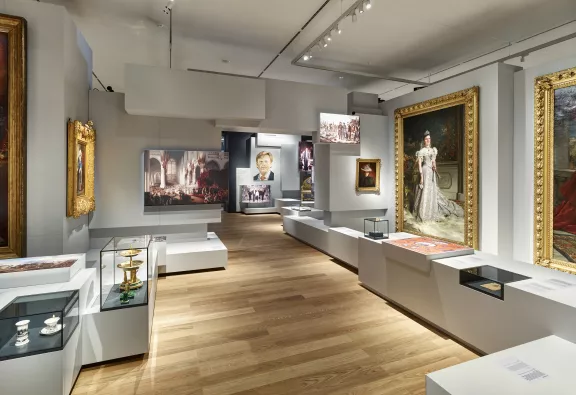
The story of Paleis Het Loo begins in 1684, when the English Princess Mary II Stuart and her husband King-Stadtholder Willem III built it as their summer palace. This is the story of Mary's life. A story of duty, betrayal and loss. Who was Mary, and what did the palace mean to her?

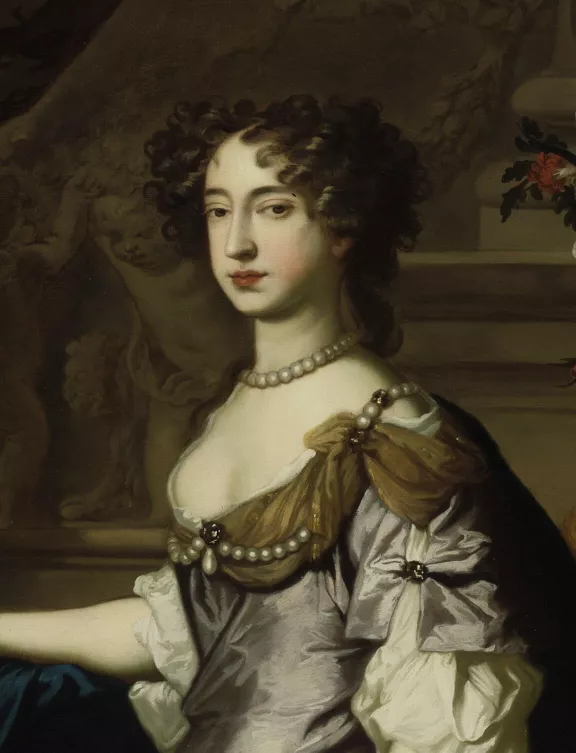
Mary’s childhood in England
Mary, daughter of the future King James II, was born in England in 1662. She spent most of her childhood at Richmond Palace, to the west of London. Her uncle, Charles II was king at the time. There was no suggestion that she would ever become queen, though she did know that she would be married off.
A new home
A suitable candidate for marriage presented himself when Mary was fifteen, and in 1677 she and her cousin, Stadtholder Willem III, were married in England. He was 27 at the time. Theirs was a political marriage. Mary was an English princess, and Willem was stadtholder of the Dutch Republic. Their union raised eyebrows across Europe, as the Republic and England had still been at war just a few years earlier. Various commemorative coins of Willem and Mary were minted to mark their wedding. Not long after the ceremony, they set sail for their new life in the Republic. This was a difficult step for Mary, who cried for days on the journey, faced with the prospect of leaving behind everything she knew to live with Willem in the Dutch Republic.

A palatial home of their own
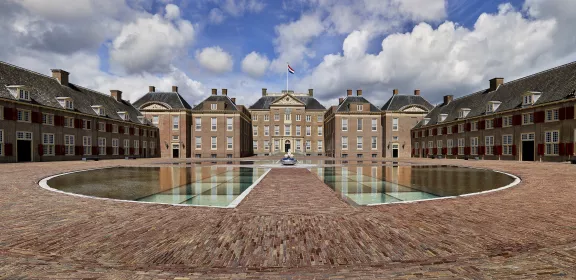
A few years into their marriage, the young couple sought a suitable location to build a palace. They settled on the Veluwe region. Willem loved hunting, and already owned the hunting rights to the area, so they had a hunting lodge built beside the medieval castle Het Oude Loo, which they had bought that year. They called the lodge Het Loo. Their choice of this precise location was based on the couple’s shared love of gardening. The site was lower than the surrounding hills, so a plentiful supply of water flowed down to it – just what they needed for a lush garden with impressive fountains.
Paleis Het Loo was Willem and Mary’s own project. It is the only palace they themselves commissioned. Other palaces like Huis ten Bosch were built by Willem’s grandfather Frederik Hendrik.
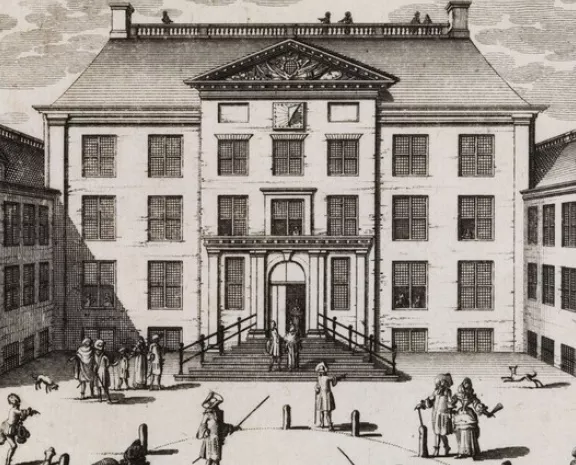
Mary laid the first stone at Paleis Het Loo on 7 May 1685. She and Willem were able to sleep there for the first time in 1686, making them the first residents of Paleis Het Loo. In the years that followed, they would relocate to Paleis Het Loo every spring, and spend an average of four months there each year. Mary’s Paleis Het Loo was more than just a palace to her. She loved the place, and was able to find peace there. She spent the summer months at her new home indulging in her many hobbies. Mary had a passion for embroidery, flower arranging and preserving flowers and fruit.

The marriage
Willem and Mary’s marriage had its highs and lows. Willem was stern and aloof. He felt more at home out hunting or in his own social circle than with Mary. He had several extramarital relationships. This affected Mary deeply. He even had an affair with one of Mary’s ladies-in-waiting, Elizabeth Hamilton. Yet the couple also seem to have respected and appreciated one another. One anecdote relates how Mary drank tea with her ladies-in-waiting on the roof of Paleis Het Loo so that she could see her husband hunting. Mary was faithful to Willem, and the couple seem to have loved each other eventually.
During her time in the Netherlands Mary suffered several miscarriages and one stillbirth. Her miscarriages caused her great suffering. Despite the orange blossom fertility symbols in her apartments, Willem and Mary never had children. And if there was one thing that was important in a monarchy, it was to produce an heir.

Partners in crime
Alongside their complicated private life, Willem and Mary were also ‘partners in crime’, devising plans while at Paleis Het Loo to overthrow Mary’s father, King James II. He was Catholic, but Willem and Mary were Protestant, like the majority of people in England. A number of English leaders therefore invited Willem to depose James, which led to the Glorious Revolution of 1688. Willem and Mary succeeded in deposing her father, and were crowned King and Queen of Ireland, England and, later, Scotland. This was an act of betrayal towards her own father, but it did bring stability to a deeply divided England.
From Het Loo to London, never to return
After their coronation, Willem and Mary often stayed in England. Their royal duties took up much of their time. Paleis Het Loo was being altered and expanded at the time, to make it fitting for Willem and Mary’s new status. Mary sent letters from England requesting updates on the latest developments. It was always the couple’s intention to return to the palace, but unfortunately Mary was never to see her new apartments. She died in England of smallpox, at the age of 32, without ever returning to Paleis Het Loo. The loss of Mary was a heavy blow for Willem. He returned to Paleis Het Loo and stayed there long after her death.
Mary’s apartments have been restored as closely as possible to the way they were in her day. During your visit, take the ‘Willem and Mary tour’ to follow in her footsteps.